Laur's Blog, Volume 5: Epistemophilia

Updated: May 14
A Love for Literature
Last semester, I took an English Studies class. We read the book, An Introduction to Literature, Criticism, and Theory, by Bennett and Royle. It served as a guide to our literary studies. Its chapters explored prominent aspects of writing and interpretation. I remember doing a project on the "God" chapter. Here, they analyzed the correlation between the Bible and literature itself. Being one of the first texts, at least, regarding the Old Testament, it curated common perceptions of culture and creation as a whole. That wasn't my favorite part of the book, however.
Epistemophilia
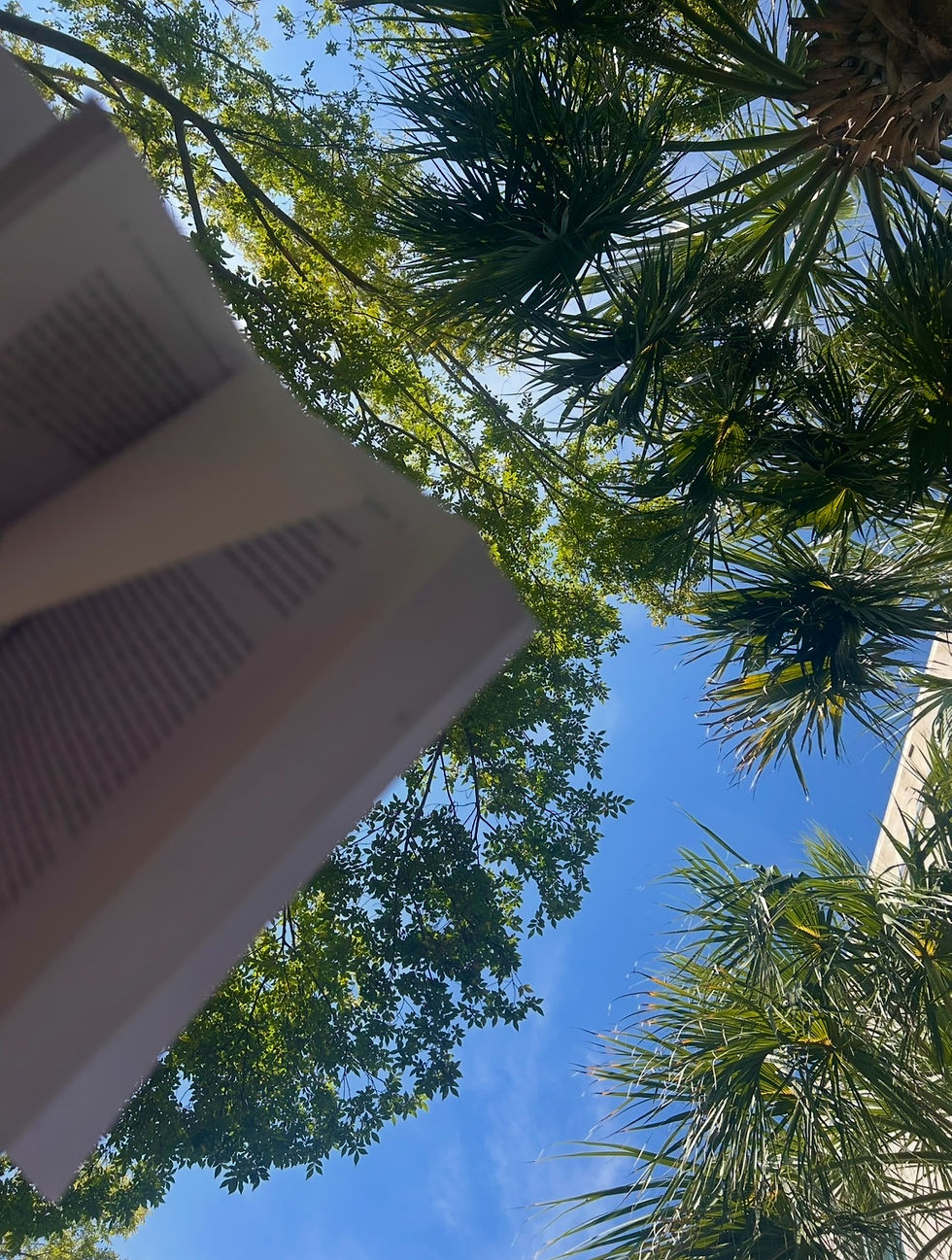
When reading for information intake, my favorite pages are always the glossaries. This book's glossary, in particular, introduced me to my new favorite word: epistemophilia. It can be described as a love of knowledge or the desire for the truth. In literary terms, it is the desire to understand the meaning produced in texts (Bennett and Royle 78).
I used to be a book nerd. My mother had me reading six books every summer, plus a different version of the dictionary each year. Some may call it nuts, but I now call it vocabulary. As I grew up, I kept reading. Never romance, however.
A Love for John Green
The summer before junior year of high school, I had to read The Anthropocene Reviewed by John Green. It’s a series of essays comparing human life now to what it should have been like. It explores differing aspects of society, analyzing how we contradict ourselves from the original principle of our being.
I re-read and annotated the book six times. Six. Maybe even more. It’s my favorite piece of literature by far. It’s also one of the last books I genuinely read for fun. After annotating the book for a fifth time, for a boyfriend of mine, sadly, I fell. I had my incident… The one where I hit my head seven times. Ever since then, reading is a task, a chore if you will. It no longer comes easily.
Stories That Still Found Me
It took me eight months to complete the last book I read for fun, Nineteen Minutes by Jodi Picoult. It’s another notably written book. It tells the story of a school shooting from the perspective of everyone involved.
One minute, you’re hearing the thoughts of the shooter himself; then the novel goes on to narrate the judge’s perspective, the officer on call on the day of the incident, and even different students involved. It’s noteworthy. Jodi Picoult’s ability to turn a traumatizing event into a beautifully sequenced, eerie, and contemplative telling is truly remarkable.
Writing Through Illness
I decided I wanted to be an English major at the age of fifteen. That’s when I had written my first “I’m mad at the world because of my illness” piece that I was genuinely proud of. I called it, “What’s on the Inside Doesn’t Matter”, a spin-off to the common saying that it’s what’s on the inside that counts.
Having an invisible disability meant that I could still be perceived as “normal”. To me, it meant that I could keep my appearance composed, and people wouldn’t see the sickness, the pain. I didn’t want the world to know. I didn’t know what my classmates, my friends, or even my family members would think of me. I didn’t want to be seen as different.
In the essay, I used a bright color, yellow, as an analogy for painting away the pain. Covering it up. In my writing, however, I went through the triumph of watching the girl that I had curated fall apart.
The yellow paint, the bright color, was ripped off; the disability was no longer invisible. Something was noticeably off. I couldn’t pretend anymore; I couldn’t live in my own little delusion. The pain was catching up to me.
Becoming the Girl I Wrote
In battling illness from a young age, I’ve learned very quickly that you never know how you’re going to feel tomorrow. You don’t know what your life will be like a week from now, let alone six months into the future. So do it. Do whatever you want to do. Live. Be happy. Take in the good, and deal with the bad. The wound won’t go away unless you allow it to heal, but don’t let it stop you from carrying on.
I described that, over time, once I adopted this mentality, all the bright, vibrant colors of the world began to associate with me. I slowly began to become the girl I had once created. I was sick, but I was beaming. I was ill, but I was me. I wasn’t just the girl with the sickness; I was okay.
Why English
I didn’t believe it when I first wrote it, but somehow, I manifested it for myself. I ended up showing it to my creative writing teacher, and he told me that I needed to publish it. He said that the way I talked about my illness needed to be shared. He encouraged me to use it as my college essay, and that I did. It got me into my dream university. Well, that, and his recommendation letter.
I still think about him often; he is the reason I chose to pursue writing and become an English major. To act upon my recurring feeling of epistemophilia. To publish the tellings of my pain. To let my downfall become my blessing. To let creativity heal the soul.
The Gift of Illness
I think I was born to be a writer, better yet, a creator. I was born to engage with literature from an informational standpoint. I was born to share my story with others. I was born to live like there is no tomorrow. I was born with the gift of illness.



Comments